N.B.: Perfection is the enemy of the good, and because of that, I have not posted at least four I've started in the past month. So, this one is the opposite, an obviously incomplete first draft, written in a single ride on a very fast O12 McKnight Express bus. It will probably take longer to type it than it took to write it. (It did, by about 3x, even without research.)
* * *
The Cause of the Cause of Death
This past week in Pittsburgh, a 53-year-old woman was struck and killed as she crossed the street. Three vehicles hit her. In a 25 mph zone. In a painted crosswalk. In broad daylight. How does this happen? Yes, the accident reconstruction experts will evaluate the cause of how this woman was killed, but nobody is looking at the cause of that: Why did this woman have to cross the street, and why were three vehicles there to run her down?
Actually, four vehicles were involved, including hers, as she was walking from the parking lot she drove to from her home that morning. It was easy to locate her home address and see what transportation choices she had. To say the least, it is enlightening.
The closest road to her home that has any bus service is _[Road A]_, requiring a walk of about a mile on _[Road B]. While I am not intimately familiar with that side of town, a quick look at _[Road B]_ on StreetView shows no sidewalk but a fairly wide shoulder, a couple feet of it actual pavement. No serious hill, moderate traffic speed (supposedly, posted [35 mph, check this]). It would have been physically possible to walk to that bus stop, but not at all pleasant, similar to my 0.8-mile hike on Perrymont.
More enlightening is that _[Road B]_ itself used to have transit service, but no longer does. In fact, there was a bus stop only a few dozen yards from her house. Checking my bus schedule archives, and doing a rough sketch of her theoretical transit commute back then, she would have had a ___-minute, [one?]-ride trip [, requiring __ transfers]. This compares with my typical ride on the Perry Highway bus, which got me into town from about as far out, roughly 10 miles, but with one transfer I could actually get there faster. But the point is, she used to have a very short walk to a bus [that got her all the way into town].
[assumption: TDP consolidation] Port Authority revamped the entire route system in 2010, consolidating lots of suburban routes. Because of this, her right-past-the-house route was eliminated, requiring her to travel that [mile] to the remaining route. So she lost her quick and easy bus stop, and it was easier for her to drive the whole way than to figure out how to get the mile down the street. That poses the question, why are there not sufficient park-and-ride spaces available to make that option viable?
[need to research] Let's also look at the reasoning behind the consolidation. Port Authority's consultants, the Nelson\Nygaard firm, looked at the ridership and productivity on each route prior to making the changes that were adopted. How useful was this route in the overall scheme of things, back in the day? [If a transfer was necessary, how easy was it to do that? Was transit really an option, even with a bus stop yards away?] Or was this a route that never should have existed in the first place, one of many routes put there because of supposed demand that never materialized?
[assumption: Route cuts] Facing an enormous deficit, Port Authority eliminated 15% of its service in March 2011, on top of a 15% cut in 2007. In this case [verify this], she lost the quick and easy route in the March 2011 cuts. Here, I put the onus squarely on state GOP leadership for the past 10 years not to come up with a funding mechanism that kept the buses running. With transit cuts came more people driving, and hence more people crossing streets from parking lots.
Short answer: No bus to ride, and/or not easy to ride, so she drove. The bus would have dropped her off at ______, a very different walk from that from the parking lot on Smallman by 14th Street.
A similar analysis should be done for each of the other drivers. Why was anyone driving? The box truck I'll give a pass to, as he was on a multi-state commercial delivery. Everyone else, though, potentially had a transit and/or bicycle option. Not only should she not have been there to run over, there should have been nobody there to run her over.
Moral of the story: Lack of transit funding helped kill this woman. Get more people out of cars and into the transit system, and fewer people will die in crashes.
Friday, December 14, 2012

Sunday, December 2, 2012
Soupaneuring Week #1: Subway in West View
Week #1, Subway in West View.
 The day did not go well, so I was lucky to be able to pull this off at all. The original plan was to take off before dawn to pick up and drop Tag-O-Rama tags, and nab a better one for Wheelset of Fortune, then catch up on some writing while I had a bowl of soup somewhere, for a bike game hat trick, as well as get together with (an)other cyclist(s) for a group construction project. It didn't happen. By the time I was ready to go out, it was raining steadily, and I was ready for a nap.
With failing light but a break in the weather, I opted for the three-mile trip into West View, where several choices of both fast food and decent restaurants awaited. I opted for Subway, which had a choice of just two institutional soups. I chose the broccoli and cheese, with a side of a white macadamia nut cookie, and chocolate milk. Total outlay, less than $5. I worked on my writing project as I dined, then with it fully dark, returned the three miles home. Total, about 6.1 miles. It also continues an uninterrupted string of going someplace purposeful at least once each week since January 1, 2012.
The day did not go well, so I was lucky to be able to pull this off at all. The original plan was to take off before dawn to pick up and drop Tag-O-Rama tags, and nab a better one for Wheelset of Fortune, then catch up on some writing while I had a bowl of soup somewhere, for a bike game hat trick, as well as get together with (an)other cyclist(s) for a group construction project. It didn't happen. By the time I was ready to go out, it was raining steadily, and I was ready for a nap.With failing light but a break in the weather, I opted for the three-mile trip into West View, where several choices of both fast food and decent restaurants awaited. I opted for Subway, which had a choice of just two institutional soups. I chose the broccoli and cheese, with a side of a white macadamia nut cookie, and chocolate milk. Total outlay, less than $5. I worked on my writing project as I dined, then with it fully dark, returned the three miles home. Total, about 6.1 miles. It also continues an uninterrupted string of going someplace purposeful at least once each week since January 1, 2012.
Sunday, October 7, 2012
Coffeeneuring #1 and Brave New World
Coffeeneuring is the practice of riding some distance on a bicycle for the primary purpose of imbibing in a beverage at a shop whose primary product is caffeinated beverages. Whether you ride two miles or 200 miles matters not, but you have to do it on your days off, and can only count one such trip in a calendar day toward several such trips over a series of weekends.
Today was my first trip out, a very short ride to check out a bicycle following a repair. Because I wasn't sure of the bike, and with there being no bus service to speak of on a Sunday for a backup, I played it safe and stuck close to home, riding only to Coffee Buddha, about 1.5 miles south on Perry Highway. My preferred shop, Perry Perk, is not open on Sundays, and I was anxious to try out this new shop.
To pass the time once I got there, I took a copy of Aldous Huxley's Brave New World with me to finish. Once that was done, I wrote the little essay that follows.
To imbibe, I invested in the Tea of the Day, an oolong blend that had some fancy name that I promptly forgot as soon as I walked away from the counter, and a yummy muffin whose name lasted about as long.
Just finished reading "Brave New World". I find in reading it that I put to use much of what I learned in past literature classes, notably Miss Harp's British Lit class in Spring 1976, my Shakespeare tragedies course at SUNY Geneseo, and my Chaucer class which, IIRC, I took the same semester as Shakespeare. To make the best sense of a work, one needs to study sources and backgrounds, understand where the story came from, and what was the world like at the time this was written. In 1931, the world was in depression, a nasty European war was just over a decade in the past, a nasty war was just about to get going in Japan and China, with unrest in Europe and Germany still. The TV had just been invented (1926) but commercial TV was still in the future (the first commercial would not be aired until 1939). Radio was dominant, including overseas broadcasts via shortwave. "Talking" motion pictures were only a couple of years old. Transportation: trolleys everywhere, cars taking over, rail was how you traveled between cities, no airlines to speak of yet, rocketry was the scientific frontier. Constant innovation in every form, everywhere. Women just got the vote in England and the U.S. in the recent past. Social stuff: The U.S. had Prohibition, recreational drugs were just being invented, penicillin had just been discovered. Political: We had socialism, fascism, and communism without the stigmas they have today, but we did have major political experimenting to try them out, in places like Russia, and as we were about to find out quite soon, Germany. The USSR's formation was well in the future. Meanwhile, Japan and China had monarchies whose forces were fomenting the next war.
I need to re-read (and read for the first time) much of Shakespeare, which is quoted extensively in BNW, sometimes in a direct quote, sometimes embedded in a phrase or thought. It's been 34 years since I made my way through Julius Caesar, Romeo and Juliet, Othello, and others, though I have never had the book far from my fingertips that whole time. But there are writings I never knew, like "The Phoenix and the Turtle", and while I've seen The Tempest, the acoustics were poor (an outdoor performance), I didn't much understand it. I know some scenes from many plays, having watched the annual monolog contest (http://www.ppt.org/shakespeare-monologue-and-scene-contest), but that doesn't help with detailed understanding of all 36 plays, 154 sonnets, and various other poems, as quoted in BNW.
A banned book. Why? Probably all the sex; it's central to the plot. Nothing graphic, just the constantness of it, the idea that everyone's conditioned to copulate constantly with no preference to any one person, and no concern about childbearing, which is rare. Though the book was written decades prior to the Pill's invention, Huxley lived to know about it, and might have seen its effects before his 1963 death.
But as to banning the book itself: I can see both the wonders and the difficulty in reading this in a high school English class. That needs an essay in itself. To me, the issue comes down to one big unanswerable question. Kids who already have the ability to understand new ideas will find enormous ways to expand their minds, while those who have not will simply be horrified, thus begging the question, why learn anything? Are we doomed to all be Deltas and Epsilons, or merely wear green uniforms and perform mid-level tasks? Can only a few be Betas to get anything requiring thought done, and fewer still Alphas to figure out anything of consequence? Or is the Savage right, and the brave new world is itself a horror?
At the time of its writing, Huxley thought this might be 600 years in the future, but by the 1946 edition, he feared this might happen within the next century. Minus the methods of travel and a few other surface details, he might be right.
A couple of pictures, and a link to the video I took for part of the way there until my battery gave out.
Photo #1, the bike rack in front:
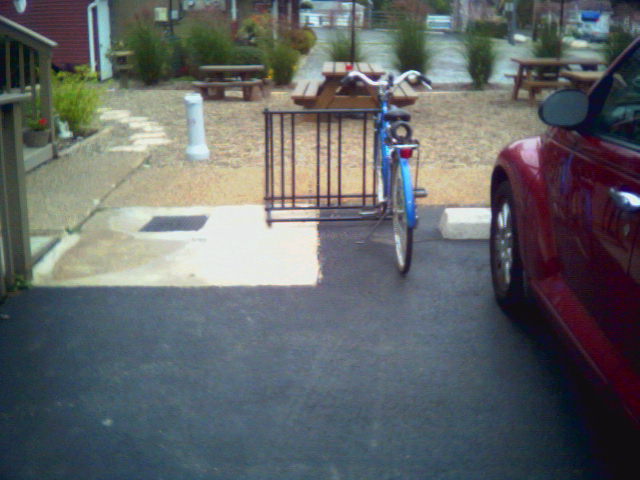
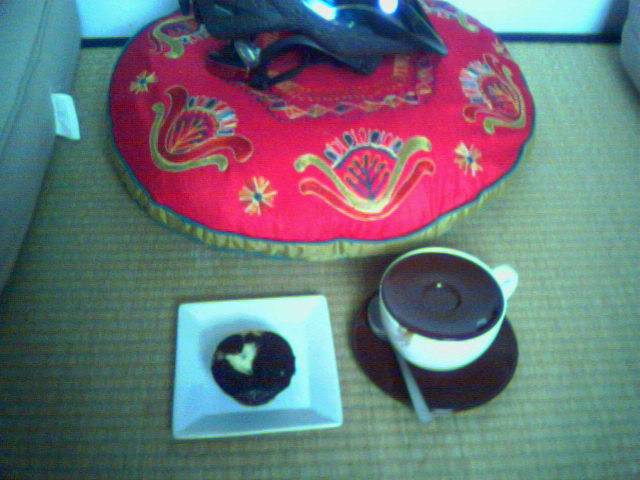
Photo #2, yummyfulness and a bike helmet.
And 5/6 of the trip there (yes, I know it's sideways, all the bike videos are):
Today was my first trip out, a very short ride to check out a bicycle following a repair. Because I wasn't sure of the bike, and with there being no bus service to speak of on a Sunday for a backup, I played it safe and stuck close to home, riding only to Coffee Buddha, about 1.5 miles south on Perry Highway. My preferred shop, Perry Perk, is not open on Sundays, and I was anxious to try out this new shop.
To pass the time once I got there, I took a copy of Aldous Huxley's Brave New World with me to finish. Once that was done, I wrote the little essay that follows.
To imbibe, I invested in the Tea of the Day, an oolong blend that had some fancy name that I promptly forgot as soon as I walked away from the counter, and a yummy muffin whose name lasted about as long.
*
Just finished reading "Brave New World". I find in reading it that I put to use much of what I learned in past literature classes, notably Miss Harp's British Lit class in Spring 1976, my Shakespeare tragedies course at SUNY Geneseo, and my Chaucer class which, IIRC, I took the same semester as Shakespeare. To make the best sense of a work, one needs to study sources and backgrounds, understand where the story came from, and what was the world like at the time this was written. In 1931, the world was in depression, a nasty European war was just over a decade in the past, a nasty war was just about to get going in Japan and China, with unrest in Europe and Germany still. The TV had just been invented (1926) but commercial TV was still in the future (the first commercial would not be aired until 1939). Radio was dominant, including overseas broadcasts via shortwave. "Talking" motion pictures were only a couple of years old. Transportation: trolleys everywhere, cars taking over, rail was how you traveled between cities, no airlines to speak of yet, rocketry was the scientific frontier. Constant innovation in every form, everywhere. Women just got the vote in England and the U.S. in the recent past. Social stuff: The U.S. had Prohibition, recreational drugs were just being invented, penicillin had just been discovered. Political: We had socialism, fascism, and communism without the stigmas they have today, but we did have major political experimenting to try them out, in places like Russia, and as we were about to find out quite soon, Germany. The USSR's formation was well in the future. Meanwhile, Japan and China had monarchies whose forces were fomenting the next war.
I need to re-read (and read for the first time) much of Shakespeare, which is quoted extensively in BNW, sometimes in a direct quote, sometimes embedded in a phrase or thought. It's been 34 years since I made my way through Julius Caesar, Romeo and Juliet, Othello, and others, though I have never had the book far from my fingertips that whole time. But there are writings I never knew, like "The Phoenix and the Turtle", and while I've seen The Tempest, the acoustics were poor (an outdoor performance), I didn't much understand it. I know some scenes from many plays, having watched the annual monolog contest (http://www.ppt.org/shakespeare-monologue-and-scene-contest), but that doesn't help with detailed understanding of all 36 plays, 154 sonnets, and various other poems, as quoted in BNW.
A banned book. Why? Probably all the sex; it's central to the plot. Nothing graphic, just the constantness of it, the idea that everyone's conditioned to copulate constantly with no preference to any one person, and no concern about childbearing, which is rare. Though the book was written decades prior to the Pill's invention, Huxley lived to know about it, and might have seen its effects before his 1963 death.
But as to banning the book itself: I can see both the wonders and the difficulty in reading this in a high school English class. That needs an essay in itself. To me, the issue comes down to one big unanswerable question. Kids who already have the ability to understand new ideas will find enormous ways to expand their minds, while those who have not will simply be horrified, thus begging the question, why learn anything? Are we doomed to all be Deltas and Epsilons, or merely wear green uniforms and perform mid-level tasks? Can only a few be Betas to get anything requiring thought done, and fewer still Alphas to figure out anything of consequence? Or is the Savage right, and the brave new world is itself a horror?
At the time of its writing, Huxley thought this might be 600 years in the future, but by the 1946 edition, he feared this might happen within the next century. Minus the methods of travel and a few other surface details, he might be right.
*
A couple of pictures, and a link to the video I took for part of the way there until my battery gave out.
Photo #1, the bike rack in front:
Photo #2, yummyfulness and a bike helmet.
And 5/6 of the trip there (yes, I know it's sideways, all the bike videos are):
And here's the rest of the ride.
Monday, October 1, 2012
What to tell a newcomer
We have a new guy at work. He's new to Pittsburgh, having just flown in here two days ago. He has no knowledge of the city, yet has to learn how to get back and forth to work. He also (so far as I know) does not drive, so has to get around via transit, or rides from co-workers and friends. His main task to do is to find someplace to live, since he is living in a motel on a day-by-day basis.
If this were you, just dropped in a new city, how would you function? Wouldn't it be helpful to have someone give you a quick primer? Especially in Pittsburgh, where topography is a major impediment to getting around, and few streets travel in a straight line for very long.
This is the email I prepared to help him.
If this were you, just dropped in a new city, how would you function? Wouldn't it be helpful to have someone give you a quick primer? Especially in Pittsburgh, where topography is a major impediment to getting around, and few streets travel in a straight line for very long.
This is the email I prepared to help him.
Some ideas come to mind of where you might stay while you
are here. I am assuming that you will be, for the most part, not using a car. I
myself am about 95% car-free, using buses and bicycle to get around.
Pittsburgh has two major downtown areas – the “Golden
Triangle” where we are now (surrounded on two sides by rivers, and an
expressway on the third), and Oakland, about 4 miles to the east, where the two
big universities (Pitt, CMU) and a lot of hospitals are located. In fact, by
itself, Oakland is bigger than every other city in Pennsylvania other than
Philadelphia and the Golden Triangle. Dozens of food and shopping choices, lots
to do (especially when surrounded by 50,000 college students).
There are many hotels both Downtown and in Oakland. Getting
here from Oakland by bus is quite simple, with at least 10 bus routes shuttling
between here and there, for about a 15- to 20-minute trip.
North, there are two brand-new hotels near the two stadiums
(Spring Hill Suites, Hyatt Place), either a free 5-minute subway ride, or about
a 10-minute walk. Possibly your best bets. A very different type of hotel is
The Priory, a five-minute bus ride, a 15-minute walk, but a bit far from the
subway.
The T only goes north to the stadiums, and south. Buses go
in every direction, and use buses-only roadways to get out of town in a hurry.
Near-South, there are hotels in Station Square (at the other
end of the Smithfield Street Bridge, about a 10-minute walk) and at the south
end of the 10th St Bridge (Holiday Inn Express, about a 20-minute
walk, or 10-minute bus ride).
Farther out South, there are hotels near South Hills Village
Mall, and about a half-hour trip on the “T” (light rail). Dormont and Mount
Lebanon are a little closer on the same subway line, but I’m not sure about
lodging.
There is no West. Well, there is, but near-West, there isn’t
much in terms of places to stay that are also foot/bus-friendly. I am probably
the only person in the office who has physically walked along every street
within five miles of downtown (and bicycled them and used most bus stops), and
working from that experience, you really don’t want to walk along some of them.
The big danger is cars, not people, and the absence of sidewalks and lighting.
As long as you stay in your room or even the hotel, you’re OK, but crossing a
street in the suburbs (like the Parkway Center Best Western) is chancy, and
walking a half mile along Mansfield Avenue is suicidal (Hilton/Doubletree in
Greentree). They probably have shuttles, or you might be able to arrange a
regular ride with someone, but my experience suggests that the easiest thing to
do is just to live close, and get around on foot, to spend the least time,
expense, and trouble in travel.
Farther out West, there are a bunch of hotels in Robinson,
and about a half-hour ride on the 28X Airport bus. Like Greentree, though,
crossing a street (like you would have to do to get from hotel to bus) is not
recommended. I’ve done it thousands of times; for seven years, I used to work
in Robinson. Not fun. Same issues as in Greentree, only six- to eight-lane streets
to cross, not merely four-lane.
Farther North, there are four hotels along McKnight Road
that I can think of. Very quick ride into town, maybe only 10 minutes for the
closer three, 15 for the next one out, but again, you have to cross a major
street on the way home. I’ve actually crossed at the points you would have to.
Not as horrible as the one in Robinson, but still not real pleasant. The near
three are Hampton Inn, Intown Suites, and Comfort Inn (just opened). The
farther out one is Holiday Inn, which has the added disadvantage of being on
top of a large hill. I call places like this Holiday Inn “completely
inaccessible to human beings except by automobile”.
If your preference is being close, I’d go with either a
place right downtown or the North Shore. Then Oakland, then Station Square or
the 10th St Bridge choice.
The bus or T is $2.50/ride, $25/week for an unlimited-use
pass, or $97.50 for the whole month, vs one taxi ride at about $15, also about
$15 to park a car for one day.
See me if you need to get around, however you decide to do
it. I also drive – both car and motorcycle – and bicycle everywhere, so can
provide you with whatever information you might need.
Hope this helps!
Sunday, September 9, 2012
The lesson of Pithole
Late July 2011, I took a trip by motorcycle to attend my high school reunion. Traveling by myself with no timetable to adhere to, I stuck to back roads and took my time. Since funds were limited, I eked out the best fuel mileage I could obtain, and succeeded. With my 250 cc bike, at one fill-up, I purchased 1.49 gallons of gas to travel 146 miles. Mission accomplished!
On my way back, the back roads took me to Pithole, Venango County, in northwest PA, site of an early oil boom town. In 1866-67, this was the third-busiest post office in Pennsylvania, after Philly & Pgh. The pipeline and the standard barrel were invented here, among other things. Riots and prostitution and sabotage, all present here -- big surprise, right?
But in a few short years, it was gone. Why? They pumped the place dry. A few tiny derricks remain, scattered around the hillsides for miles around, but at Pithole itself, nothing. What little petroleum those scattered derricks produce today likely would not support the daily travels of nearby Pleasantville, let alone any substantive amount of the region, state, or world.
It's gone. It's used up. Forty years before the first Model T Ford appeared, the oil from our first oil boom was history, and nobody has found any more there since. Almost 150 years later, we have other Pithole-like sites. We came, we drilled, we sucked it dry, we moved elsewhere.
Only one problem: We're running out of elsewheres. Just what does anyone plan to do when we've run all the big oil pools dry, too? Sure, there was a lot of oil under Texas and California and Mississippi once, too, but they are long past peak. So is Alaska. So is Egypt. Mexico, Venezuela, Kuwait, Saudi Arabia, all are close to peak if not past it. Within a generation, the world's biggest producers will be net importers. When demand outstrips supply by any means of production, everywhere, does anyone have a plan?
Measure it however you like, drill everyplace you care to, but eventually, they will all be like Pithole: A big empty field where oil used to be.
On my way back, the back roads took me to Pithole, Venango County, in northwest PA, site of an early oil boom town. In 1866-67, this was the third-busiest post office in Pennsylvania, after Philly & Pgh. The pipeline and the standard barrel were invented here, among other things. Riots and prostitution and sabotage, all present here -- big surprise, right?
But in a few short years, it was gone. Why? They pumped the place dry. A few tiny derricks remain, scattered around the hillsides for miles around, but at Pithole itself, nothing. What little petroleum those scattered derricks produce today likely would not support the daily travels of nearby Pleasantville, let alone any substantive amount of the region, state, or world.
It's gone. It's used up. Forty years before the first Model T Ford appeared, the oil from our first oil boom was history, and nobody has found any more there since. Almost 150 years later, we have other Pithole-like sites. We came, we drilled, we sucked it dry, we moved elsewhere.
Only one problem: We're running out of elsewheres. Just what does anyone plan to do when we've run all the big oil pools dry, too? Sure, there was a lot of oil under Texas and California and Mississippi once, too, but they are long past peak. So is Alaska. So is Egypt. Mexico, Venezuela, Kuwait, Saudi Arabia, all are close to peak if not past it. Within a generation, the world's biggest producers will be net importers. When demand outstrips supply by any means of production, everywhere, does anyone have a plan?
Measure it however you like, drill everyplace you care to, but eventually, they will all be like Pithole: A big empty field where oil used to be.
Friday, August 24, 2012
Doorknob to desk
"Doorknob to desk."
I’ve been using the term for years, but what does it mean, really? The simple answer is that it measures my travel time, my commute, from the time I leave my house to the time I reach my desk, ready to do work. It’s what’s implied that makes it less simple. By employing this obvious simplicity, I reduce all the variables concerning travel time of one’s method of travel to a single integer.
Going by car? You had to scrape the frost off the window, shovel the driveway, stop for gas, find a parking space, and walk from that spot to your place of employment. Going by bus? You had walking time to get to the stop, some minutes to wait for it to arrive, perhaps make a transfer with its own travel and wait. Going by bike? Fill tires and secure load before getting underway, then lockup and maybe a quick wipedown or change of clothes upon arrival.
What it also accomplishes is to eliminate bias. As a transit rider, car commuters routinely ask, “How long does it take you to get here by bus?” Implied in that question lies a bias that travel time is of utmost importance. I want to respond with a question of my own, “Why would that matter?” But I reply with a simple question: "Of course going by car might take less time, but it also costs me $14/day to park, and I have better things to do with a couple hundred a month. What do you value?"
In offering an integer for my travel time by bus or bike, I often get the reply, “Ha! I can get here in only 20 minutes!” In so doing, they measure a best case scenario, and then only the time from the moment a tire hits a road to the time they pull into the parking lot, as if all that other stuff on both ends doesn’t count. But it does. Worse, the majority of people I’ve conversed with, hundreds over 20+ years, employ a best-case scenario that involves no traffic lights, no traffic, and traveling 10 mph over the speed limit.
Doorknob to desk, at or below the speed limit, with car prep, fueling, scraping, shoveling, and parking issues included, levels the playing field, making those travel times comparable.
What D-to-D does not do is attempt to compare the subjective values of differing travel modes. A transit user can take a nap, but a driver and cyclist cannot. A transit rider can skip the snow shovel, read a book, send a text, and get work done on the way, something a motorist cannot do. A bicyclist is getting a workout and pays no travel cost, but is subjected to the elements. A motorist has great comfort, but at an order of magnitude greater cost. Being subjective, each person will value all these differently, and that’s fine.
This one measure, though, merely reduces travel time to a single value. Do with it what you will. I no longer value the shortest travel time as important. For me, cost is a big factor, so is personal health. Changing my mind on these has let me look at life differently from when I was one of those maniacs behind the wheel. It’s only a number, but you have to start somewhere.
I’ve been using the term for years, but what does it mean, really? The simple answer is that it measures my travel time, my commute, from the time I leave my house to the time I reach my desk, ready to do work. It’s what’s implied that makes it less simple. By employing this obvious simplicity, I reduce all the variables concerning travel time of one’s method of travel to a single integer.
Going by car? You had to scrape the frost off the window, shovel the driveway, stop for gas, find a parking space, and walk from that spot to your place of employment. Going by bus? You had walking time to get to the stop, some minutes to wait for it to arrive, perhaps make a transfer with its own travel and wait. Going by bike? Fill tires and secure load before getting underway, then lockup and maybe a quick wipedown or change of clothes upon arrival.
What it also accomplishes is to eliminate bias. As a transit rider, car commuters routinely ask, “How long does it take you to get here by bus?” Implied in that question lies a bias that travel time is of utmost importance. I want to respond with a question of my own, “Why would that matter?” But I reply with a simple question: "Of course going by car might take less time, but it also costs me $14/day to park, and I have better things to do with a couple hundred a month. What do you value?"
In offering an integer for my travel time by bus or bike, I often get the reply, “Ha! I can get here in only 20 minutes!” In so doing, they measure a best case scenario, and then only the time from the moment a tire hits a road to the time they pull into the parking lot, as if all that other stuff on both ends doesn’t count. But it does. Worse, the majority of people I’ve conversed with, hundreds over 20+ years, employ a best-case scenario that involves no traffic lights, no traffic, and traveling 10 mph over the speed limit.
Doorknob to desk, at or below the speed limit, with car prep, fueling, scraping, shoveling, and parking issues included, levels the playing field, making those travel times comparable.
What D-to-D does not do is attempt to compare the subjective values of differing travel modes. A transit user can take a nap, but a driver and cyclist cannot. A transit rider can skip the snow shovel, read a book, send a text, and get work done on the way, something a motorist cannot do. A bicyclist is getting a workout and pays no travel cost, but is subjected to the elements. A motorist has great comfort, but at an order of magnitude greater cost. Being subjective, each person will value all these differently, and that’s fine.
This one measure, though, merely reduces travel time to a single value. Do with it what you will. I no longer value the shortest travel time as important. For me, cost is a big factor, so is personal health. Changing my mind on these has let me look at life differently from when I was one of those maniacs behind the wheel. It’s only a number, but you have to start somewhere.
Saturday, August 4, 2012
H.C. Frick never foresaw this
I work in Henry Clay Frick's building in downtown Pittsburgh. The first Friday of every summer month, the Frick Art & Historical Society holds a(n essentially) free concert on the lawn of Clayton, Frick's mansion. Tonight, I traveled from one to the other, effectively replicating old man Frick's commute home. I bet he never figured to make the trip the way I did.
We would have started the same way. Here is the view from the elevator: Henry Clay Frick's office door, now the door to the company mail room, supply closet, and kitchenette.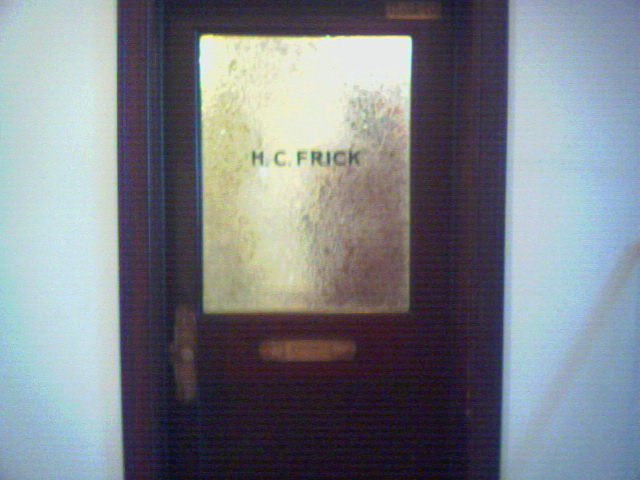 I took the elevator down from 20 and walked out onto Fifth Avenue, just like he did. I then walked over to the Liberty/Smithfield parking garage, where I had the bicycle tied up, and rode over to Grant Street, by U.S. Steel Tower. In fewer than five minutes, the bike and I were on an articulated bus, an express trip out the East Busway. In 15 minutes, I was off the bus at Homewood Avenue, unmounted the bike from the bus rack, and descended the steps. Clayton is a mere three blocks from the busway station. In just a couple of minutes on the bike, I was here:
South view of Clayton, the H.C. Frick mansion, during The Bobs' concert, Aug 3 2012.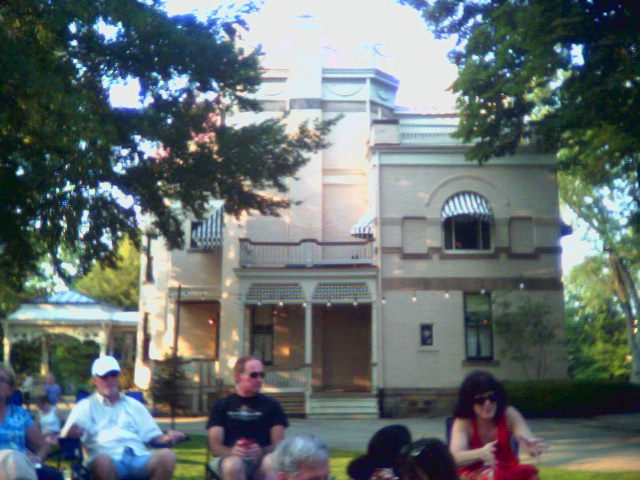
The trip from desk to (essentially) doorknob took only 38 minutes. I am guessing Frick himself never made it that quickly, and I wasn't even hurrying. In fact, I waited out lights at Wm Penn Way, Grant Street, and Penn Avenue, though I got the light at Thomas Boulevard green.
The truth be told, though, I don't know how Frick commuted. Possibly he had a driver to carry him back and forth on city streets. Maybe he used the trolley; I doubt it. For all I know, he had a private streetcar. I'm pretty sure he didn't do it by horse or bicycle, though he may have been able to drive it himself. He died in 1919. To this day there is a museum of antique cars on the Clayton grounds, worthy of a look to see how the upper-crust of Pittsburgh society got around 100 years ago.
Endnotes
Here are a couple of links about Frick:
We would have started the same way. Here is the view from the elevator: Henry Clay Frick's office door, now the door to the company mail room, supply closet, and kitchenette.
I took the elevator down from 20 and walked out onto Fifth Avenue, just like he did. I then walked over to the Liberty/Smithfield parking garage, where I had the bicycle tied up, and rode over to Grant Street, by U.S. Steel Tower. In fewer than five minutes, the bike and I were on an articulated bus, an express trip out the East Busway. In 15 minutes, I was off the bus at Homewood Avenue, unmounted the bike from the bus rack, and descended the steps. Clayton is a mere three blocks from the busway station. In just a couple of minutes on the bike, I was here:South view of Clayton, the H.C. Frick mansion, during The Bobs' concert, Aug 3 2012.
The trip from desk to (essentially) doorknob took only 38 minutes. I am guessing Frick himself never made it that quickly, and I wasn't even hurrying. In fact, I waited out lights at Wm Penn Way, Grant Street, and Penn Avenue, though I got the light at Thomas Boulevard green.
The truth be told, though, I don't know how Frick commuted. Possibly he had a driver to carry him back and forth on city streets. Maybe he used the trolley; I doubt it. For all I know, he had a private streetcar. I'm pretty sure he didn't do it by horse or bicycle, though he may have been able to drive it himself. He died in 1919. To this day there is a museum of antique cars on the Clayton grounds, worthy of a look to see how the upper-crust of Pittsburgh society got around 100 years ago.
Endnotes
Here are a couple of links about Frick:
Subscribe to:
Posts (Atom)